Life Crushes Naturalism
Homochirality
Protein Folding
Protein Binding
Functiional RNA
Genetic Coding
Life requires 5 interwoven and codependent biochemical stages, each established by modern molecular biology and are a matter of empirical fact. Decades of experimental research and peer-reviewed studies show that none of them have ever been produced by unguided chemistry, not individually and certainly not together.
Because these stages are dependent on each other, failure at any point halts the entire process, leaving naturalism with no viable path to life. Naturalism collapses before life even begins.
Homochirality
Protein Folding
Protein Folding
Genetic Coding
Functiional RNA
Homochirality
Protein Folding
Protein Folding
Genetic Coding
Stage
Evolutionary probabilities in 2025
Historicity of Jesus
Stage 1 : Homochiraliity
See the science
Naturalism collapses before chemistry starts.
(dropdown)
Life requires a single molecular handedness to function, but prebiotic chemistry never produces it.
With zero evidence for any natural pathway to biological homochirality, life cannot even begin its first step.
Naturalism collapses before chemistry starts.
This is empirically verifiable. The unresolved barrier is documented across decades of peer-reviewed research:
Donna G. Blackmond (2010, 2020)
Gerald F. Joyce & Leslie Orgel (1999)
Jack W. Szostak (2000-2020
Ronald Breslow — Columbia University
20+ peer reviewed studies
Why Homochirality is Fatal to Naturalism
“Homochirality remains an unsolved problem, and all RNA-based models depend on it.”
Gerald Joyce (Salk Institute), one of the world’s most respected RNA-world pioneers.
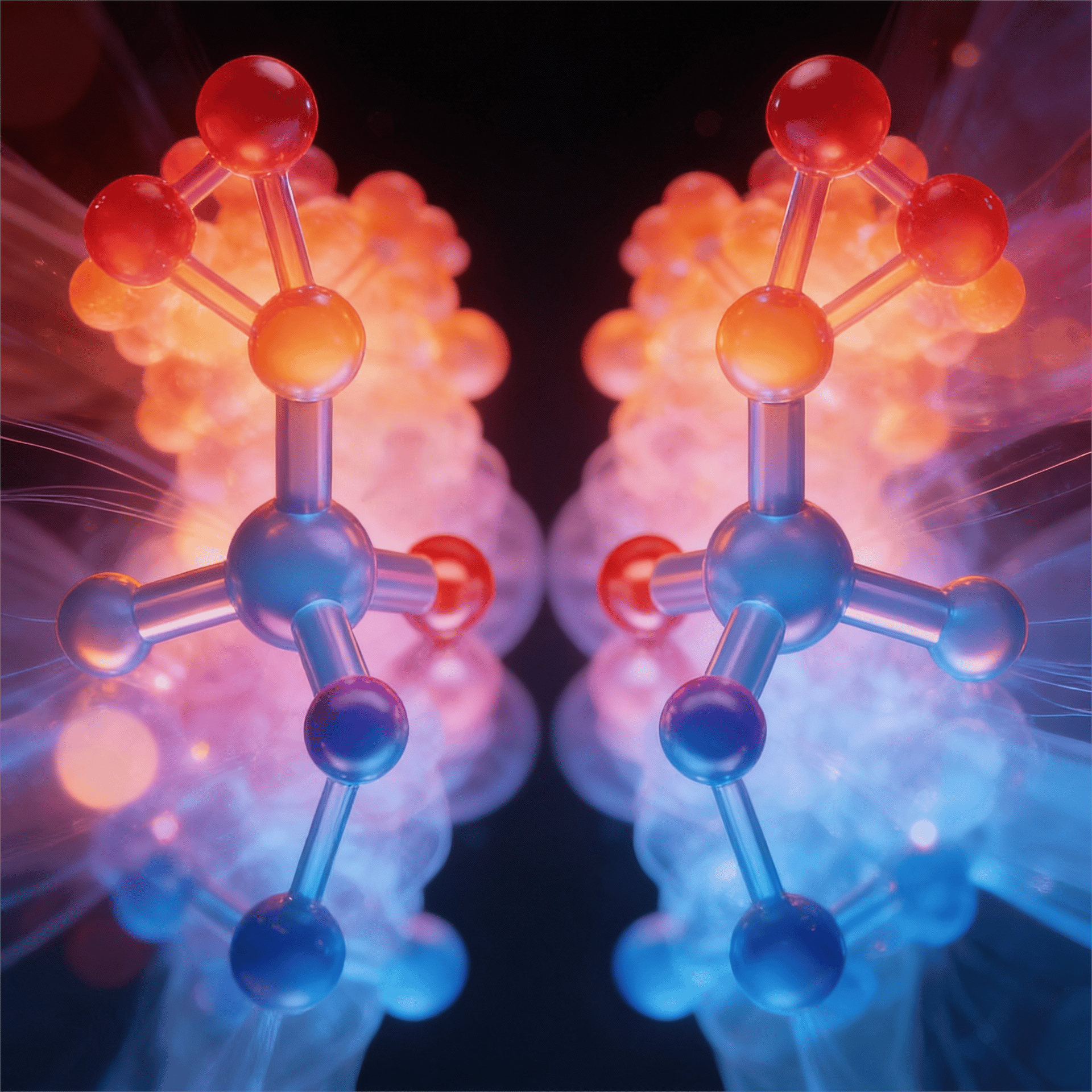
Life requires 100%
pure L-amino acids, D-sugars. No exceptions — every protein and RNA/DNA strand depends on it. Prebiotic chemistry never produces 100% pure homochirality.
Prebiotic chemistry
only makes 50/50 mixtures. No experiment has ever produced biological homochirality naturally
Mixed chirality
kills function instantly. No folding → no catalysis → no replication → no life.
What science found
Stage 2 : Protein Folding
See why
Life requires stable 3D folding. Random chains don’t do it.

Life requires proteins that reliably fold into stable three-dimensional structures—but unguided chemistry overwhelmingly fails to produce them.
Enzymes—the proteins that power life’s chemistry—must fold into precise shapes, yet most possible protein sequences do not form stable structures.
Decades of research have not demonstrated a prebiotic pathway to functional, folded proteins.
Without folding, there is no biological function. This constraint is empirically observed:
Jack W. Szostak and Gerald Joyce
2023 Nature News summary
Tokuriki & Tawfik (2009)
Dill et al. (2008)
20+ peer reviewed studies
Why Protein Folding is Fatal to Naturalism
It is essentially impossible for a protein to fold correctly by a random search of conformational space.
— Conclusion of Cyrus Levinthal’s work, known as the Levinthal Paradox
Folding
is a physics constraint, not a “later evolutionary feature”
Folding requires precise, long-range interactions and stable energy landscapes — without that, there is no function.
Most sequences
don’t fold into stable, functional structures. Large experimental libraries show that stability is rare and fragile; small changes often destroy folding and function.
Unfolded chains
don’t “wait around” to become life.
They aggregate, hydrolyze, and fail chemically. Without stable folds, there are no enzymes, no replication machinery, no metabolism.
What science found

Unsubstantiated Objections
Close
Stage 3 : Functional Enzymes
See the science
Life requires enzymes that unguided chemistry doesn't produce
Life runs on enzymes — highly specific proteins that catalyze every reaction required for metabolism, replication, repair, and energy use.
But prebiotic chemistry has never demonstrated a pathway to functional protein enzymes.
Even the simplest living cells require hundreds of distinct, coordinated enzymes working together.
No demonstrated prebiotic pathway bridges that gap. Naturalism collapses before biology can begin.
The underlying constraints are experimentally measurable:
Douglas D. Axe (2004)
Keefe & Szostak
Tokuriki & Tawfik (2009)
Fowler & Fields (2014)
10+ peer reviewed studies
Why Functional Enzymes are is Fatal
to Naturalism
The vast majority of possible protein sequences do not adopt stable, functional structures.” [ 1 in 1077]
Jack W. Szostak, Leading Origin-of-Life Researcher
1 in 1077
Functional enzymes are astronomically rare. Peer-reviewed laboratory experiments led to an estimate of roughly 1 in 10⁷⁷ sequences for the tested enzyme function.
Life requires
hundreds of enzymes simultaneously. Replication, transcription, translation, metabolism, transport, and repair all require distinct enzymes. Finding even one by chance is implausible; finding hundreds together is impossible.
Natural selection
cannot help. Selection requires replication. Replication requires enzymes. Enzymes must exist before evolution can begin.
What science found
Stage 4 : Functional RNA
See the science
Life requires self-replication. Chemistry can’t do it.
Life requires systems that can copy and modify instructions—but chemistry alone does not produce self-directed processes.
RNA must act as both material and machine: it must store instructions, copy them, and catalyze the reactions that keep those instructions intact.
But unguided chemistry produces only inert strands that degrade, miscopy, and fail to coordinate these tasks.
Despite decades of RNA-world research, no experiment has ever produced a self-sustaining, self-replicating RNA system under prebiotic conditions.
This constraint is empirical, not philosophical:
Gerald Joyce, (2002).
Prywes, N., Blain, J.C (2016)
Manfred Eigen (1971)
Leslie Orgel, (2004).
20+ peer-reviewed RNA studies
Why Functional RNA is Fatal to Naturalism
“The spontaneous emergence of a self-replicating system capable of Darwinian evolution remains a central unsolved problem.”
Gerald Joyce (Salk Institute), one of the world’s most respected RNA-world pioneers.
RNA must catalyze
its own persistence. Proteins can be passive, but RNA must: template, catalyze, and survive long enough to do both.2
No known chemistry produces molecules that act to preserve themselves.
RNA must coordinate
multiple functions at once. A ribozyme must: fold correctly, bind substrates, catalyze reactions, avoid self-destruction, and maintain sequence integrity.
RNA cannot begin
evolution without already evolving
Selection requires: replication, fidelity, and heritable variation. But RNA-world models require selection to explain replication. That is causal circularity, not a pathway.
375px667px0º320px520px100%None0px0px0px0px80px48%Mixed16px
What science found
Stage 5: Genetic Coding
Learn more
Life requires a code, and chemistry doesn’t generate codes.
Even if you grant that stages 1-4 can function completely unguided - which they do not, or all together, which we have never observed - life is not just molecules. Life is encoded instruction: a mapping system where molecules and sequences “mean” something functional.
DNA and RNA are only informative when a decoding system exists to translate sequences into proteins.
Peer-reviewed research shows that the genetic code is a real system, a process that had to originate fully formed.
This is the central barrier: The code is needed to build the machinery—but the machinery is needed to read the code.
This is empirically verifiable:
Crick ( JMB) 1968
Eugene V. Koonin (2007)
Eigen (1971)
Freeland & Hurst
30+ peer reviewed studies
Why Genetic Coding is Fatal to Naturalism
“The translation apparatus represents a level of organization fundamentally different from chemistry.”
Carl Woese, Proceedings of the National Academy of Sciences
A code is not a chemical bond
it’s a mapping rule. pure L-amino acids, D-sugars. The genetic code is a structured correspondence between codons and amino acids; that correspondence is implemented by cellular machinery, not by physics alone.
Translation is a chicken-and-egg
dependency. To use DNA/RNA as instructions, you need translation machinery. But that machinery is made of proteins whose sequences must already be encoded and decoded. Koonin explicitly frames origin-of-life as a replication/translation problem
Error thresholds limit
how much information you can preserve without advanced machinery
The "Eigen’s paradox”shows that without high-fidelity replication/error correction, long information-bearing sequences degrade faster than they can be maintained.
What science found
Unsubstantiated Objections
Close
Unsubstantiated Objections
No Homochirality
=
Life can't begin
Life requires single-handed molecules—never shown to arise from
unguided chemistry, only existing living organisms.
Jump to:
No protein folding
=
No stable form
Proteins only function when folded—random chains don’t produce
stable forms.
Jump to:
No protein binding
=
No enzymes
Enzymes require precise interactions—chance doesn’t produce
that specificity.
Jump to:
No Functional RNA
=
No replication
Replication needs functional RNA—never demonstrated from
chemistry alone.
Jump to:
No Genetic Code
=
No evolution
Information requires a code—chemistry doesn’t generate
translation systems.
Jump to:
What the above empirically demonstrates...